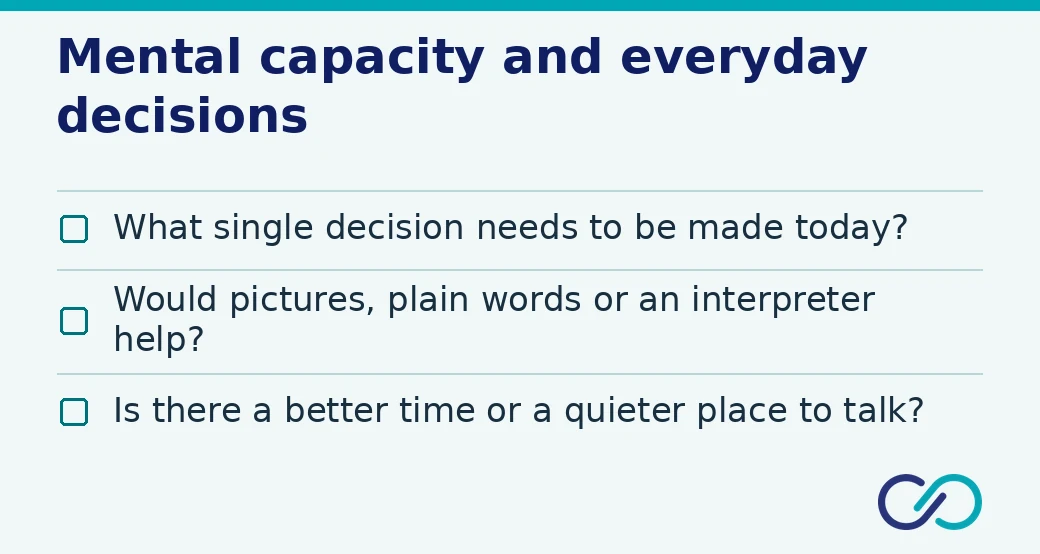
Mental capacity means being able to make a particular decision at the time it needs to be made. A person might be able to choose where to eat today but need help to understand a complex financial decision. Start by asking what decision is needed and what would help the person make it themselves.
Which law applies in England and Wales?
The Mental Capacity Act 2005 (MCA) explains how to support decision-making and what to do when a person cannot make a particular decision. The MCA came into full force on 1 October 2007 in England & Wales.
The Code of Practice explains how to apply the Act. Professionals and paid carers, as well as attorneys and deputies acting within the Act, must have regard to the Code when carrying out the relevant duties.
Five principles for decisions about mental capacity
1. Start by assuming the adult has mental capacity for the decision. Anyone who thinks otherwise needs evidence. Age, appearance, disability or a medical diagnosis alone cannot answer that question.
2. Give the person all practicable help to decide before concluding they cannot do so. Try words, pictures, signs or another format the person prefers. In some cases, an independent advocate may be able to help.
3. An unwise decision on its own does not show that someone lacks mental capacity.
4. If a person lacks capacity, any decisions or actions taken on their behalf must be taken in their best interests (unless they have made a relevant and valid decision in advance to refuse medical treatment). It is still important to involve the person wherever possible in making the decision.
5. People who lack capacity should not be restricted unnecessarily. So the person making the decision or taking the action must decide or act in a way that would cause little interference with the freedom and rights of the person who lacks capacity.
What does it mean to lack mental capacity for a decision?
If you have mental capacity, you are able to make decisions for yourself. Capacity is specific to the decision and the time. Under the Act, a person lacks capacity for a decision if an impairment of, or disturbance in, the functioning of the mind or brain means they cannot make that decision. The assessment considers whether they can:
Understand information given to them
Retain that information long enough to be able to make a decision.
Weigh up the information available to make a decision.
Communicate their decision in any way. This could be speech, sign language, a blink or a hand squeeze.
The Mental Capacity Act applies to situations where you may be unable to make a particular decision at a particular time, to the extent that you can’t do one or more of the points above.
For example, someone with dementia may be unable to retain information long enough in order to make decisions, or someone with a mental health problem may feel too depressed to make a decision that he or she is able to make when feeling less depressed. However, in these instances, this does not necessarily mean that a person lacks all capacity to make any decisions at all.
An example of this could be a person with a learning disability who may lack the capacity to make complex decisions, but this does not necessarily mean that they can’t decide what to eat, wear and do each day.
Sources and further reading: Mental Capacity Act Code of Practice and GOV.UK guidance on assessing capacity. Read our LPA guide or explore the Knowledge Centre.