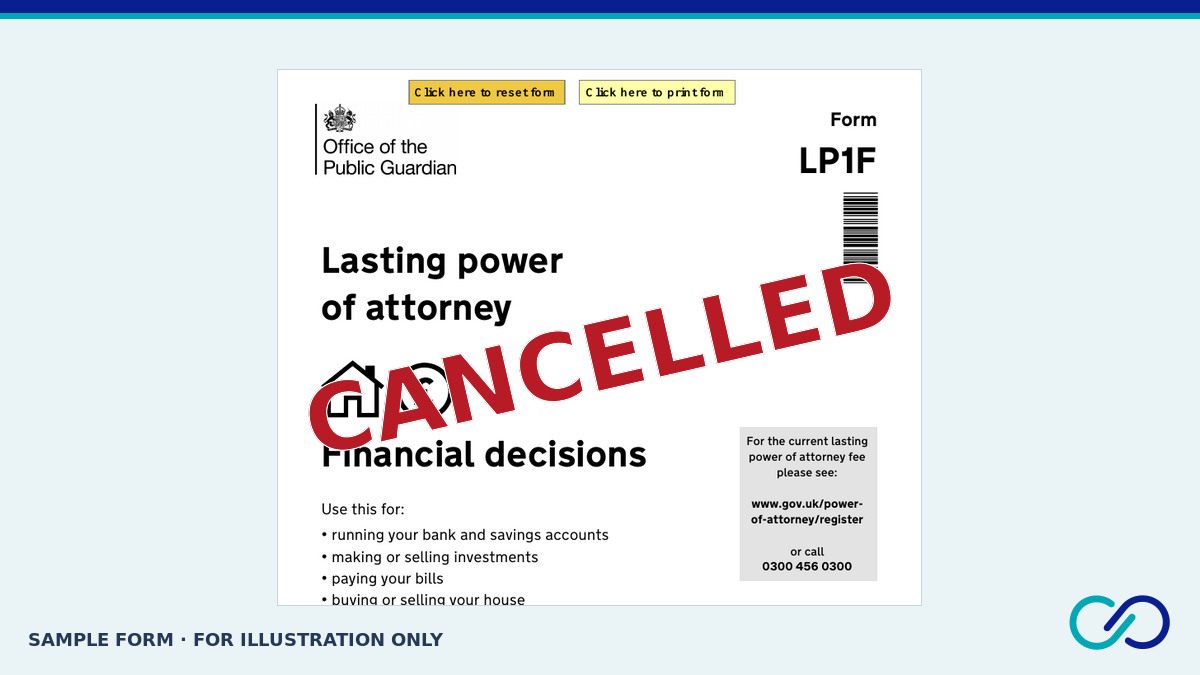
“Mum’s signed her power of attorney. So why can’t I pay her bills?”
Imagine your mum has had a stroke and can no longer manage her finances. The bills are still coming in, and there’s a care invoice to pay. She named you as her attorney, and you know exactly where the paperwork is. Then you find out the application was sent back because of a signing error. It was never registered.
That’s when a paperwork problem becomes a family problem.
Signed doesn’t mean ready to use
In England and Wales, a lasting power of attorney (LPA) can’t be used until it’s registered with the Office of the Public Guardian (OPG). Being named on the form isn’t enough, and being someone’s next of kin doesn’t automatically give you the right to manage their bank account.
The OPG rejected 48,945 LPA applications in 2024/25. Provisional figures for 2025/26 put the number at 39,781. These figures were obtained through a Freedom of Information request. They count applications, not people, and cover all applications—not just DIY ones. They don’t tell us whether people who filled in their own forms were more likely to have them rejected.
What if the application is sent back?
Some mistakes can be corrected. Others mean you have to start again. And that’s the bit people don’t always realise: if your mum no longer has the mental capacity to make a new LPA, she can’t simply sign another one.
If there’s no valid LPA that can be registered and someone needs legal authority to manage her finances, they may have to apply to the Court of Protection to become a deputy. That can mean more paperwork, fees and waiting at a time when the family already has plenty to deal with.
If you’re doing it yourself, don’t stop at signing
There’s nothing wrong with making your own LPA. But don’t put the signed forms in a drawer and assume everything’s sorted. Check who needs to sign and in what order, send the application for registration early, and deal promptly with any letter from the OPG. Once it’s registered, make sure your attorneys know where to find it. The OPG’s checklist for avoiding common LPA mistakes is a good place to start.
Talk to us about your lasting power of attorney
If you’ve started an LPA and got stuck, had an application returned, or would rather have help from the start, get in touch with Nene Legal. We’ll help you work out what to do next.
Call 01933 588 990, email enquiry@nenelegal.co.uk, or read more on our Lasting Power of Attorney page.